
Humour · fictional vignettes · № 002 — FIELD ACOUSTICS · GENSETS
How to Listen to a Generator.
Every generator in Nigeria is talking. Almost nobody is listening. A field guide for the curious.
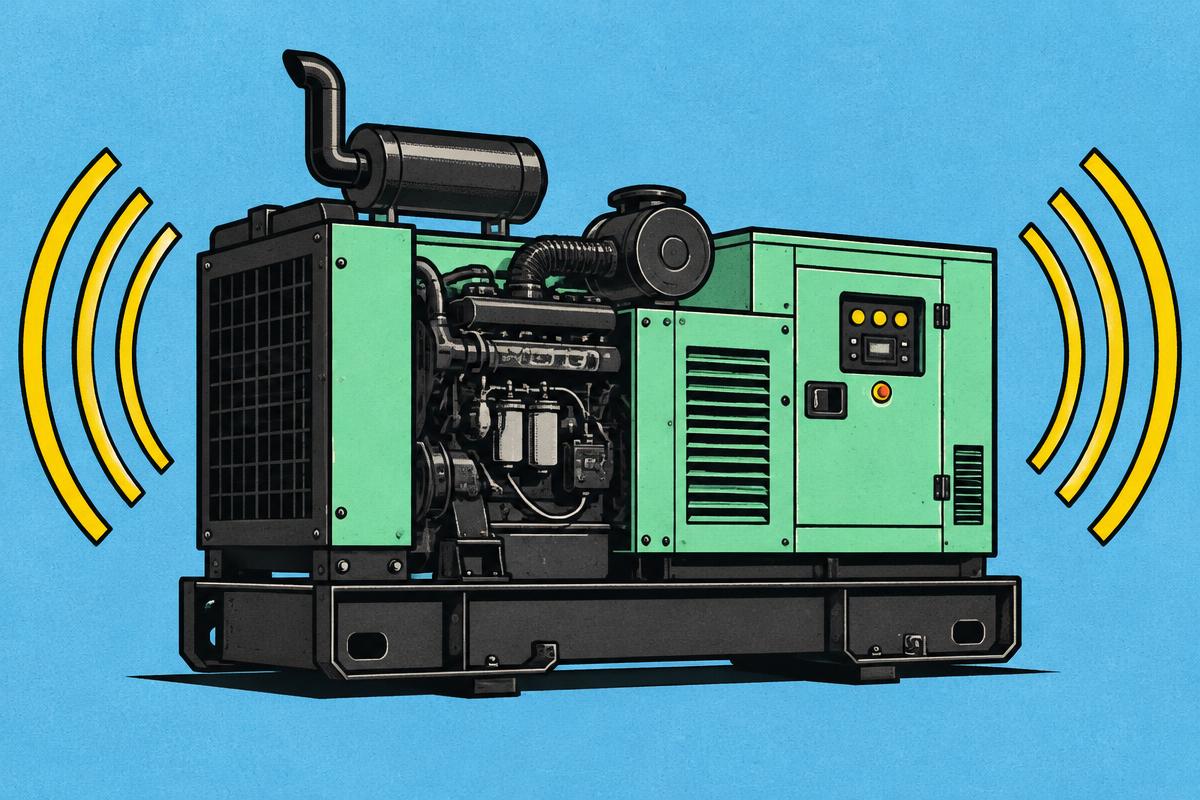
WORDS: CRUDE AWAKENING EDITORIAL · ARTWORK: GENERATED EDITORIAL ILLUSTRATION
Stand next to a running generator at two in the morning — as one does — and you will notice that it is not making noise. It is making a statement. The statement is: I am holding back the dark, and I would like some diesel please.
A generator supplying 50 Hz electricity does not necessarily make a single 50 Hz audible note. Engine speed, cylinder count, load and the enclosure all shape its sound. The familiar chug is not a universal firing rate. Operators may call an evenly running machine 'running sweet'; here, the phrase is an appreciation, not a diagnostic test.
Now learn the warnings. A generator that is starved of fuel does not simply stop — it first develops a hesitation, a small apologetic cough in the rhythm, like a singer who has forgotten one word of the song. A clogged filter adds a wheeze at the top end. A failing injector produces a knock that experienced mechanics describe as 'expensive'.
The reassuring sound is not one universal note. It is a familiar machine behaving as its operator expects.
The most beautiful moment in generator acoustics is the key change. When a large load switches off — the cold room, the welder, the entire second floor — the engine note drops and settles, audibly relaxing, like a man sitting down after carrying something heavy up the stairs. Operators who love their machines can hear this from another building and will nod, once, to no one.
There is also the silence. The silence of a generator that should be running and is not is the loudest sound in Nigerian commerce. It has a pitch (high), a tempo (frantic) and a key (panic). It is usually followed by a phone call to someone like us.
This is, in the end, why we take diesel personally. Every litre we deliver is a vote against the silence. The generator does not care about your invoice terms or your procurement process. It cares about the tank. Listen to it — but let a qualified technician, not a literary field guide, diagnose a fault.